


Future of Cloud Computing: Trends, Benefits, and Career Opportunities

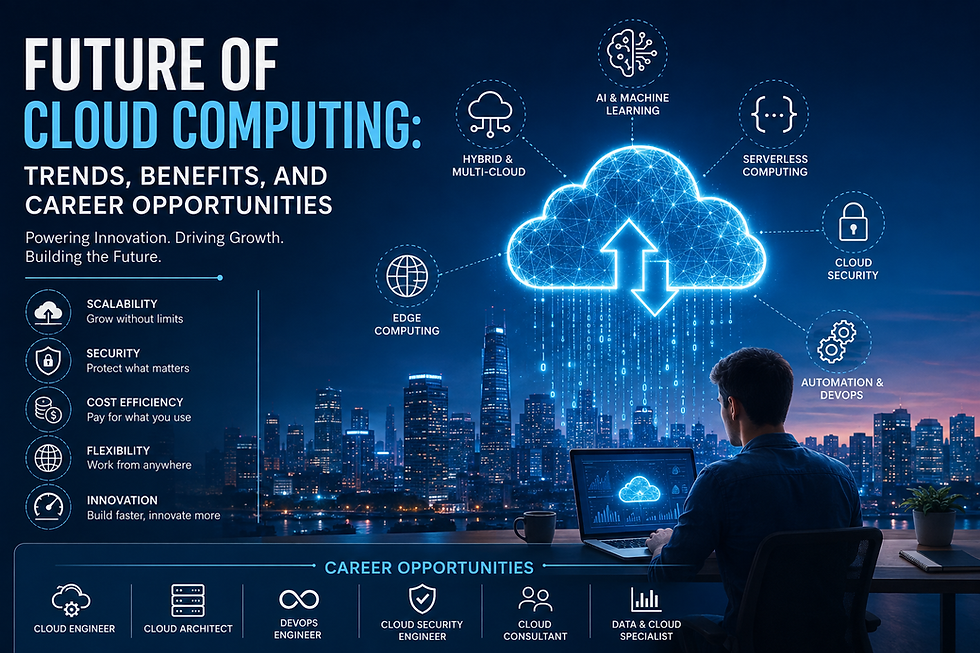
Cloud computing has transformed the way businesses store data, run applications, and deliver digital services. From startups to large enterprises, organizations are increasingly moving their operations to cloud platforms to improve flexibility, security, scalability, and cost efficiency.
As technologies such as artificial intelligence, machine learning, edge computing, and automation continue to develop, cloud computing is expected to become even more important. Understanding the future of cloud computing can help students, professionals, and businesses prepare for emerging opportunities.
In this guide, we explore the latest cloud computing trends, the Benefits of Cloud Computing, and the career opportunities available in this rapidly growing field.
What Is Cloud Computing?
Cloud computing is the delivery of computing resources such as servers, storage, databases, networking, software, and analytics through the internet. Instead of maintaining physical infrastructure, users can access technology resources whenever required.
Cloud services can support everything from simple data storage to complex enterprise applications. Businesses can scale their resources according to demand without investing heavily in physical hardware.
The main cloud service models include Infrastructure as a Service (IaaS), Platform as a Service (PaaS), and Software as a Service (SaaS).
Why Is Cloud Computing Important?
Cloud computing has become an essential part of modern digital infrastructure. It allows organizations to access computing resources quickly while reducing dependence on traditional physical infrastructure.
Businesses can use cloud platforms to develop applications, analyze data, support remote employees, improve collaboration, and launch digital services.
The growing adoption of artificial intelligence, big data, Internet of Things (IoT), and machine learning is also increasing demand for flexible cloud infrastructure. As digital transformation continues, cloud computing is likely to remain a major technology for businesses worldwide.
Benefits of Cloud Computing
The Benefits of Cloud Computing make it an attractive solution for businesses and individuals. Cloud technology can reduce infrastructure costs because organizations do not always need to purchase and maintain large amounts of physical hardware.
Other advantages include scalability, flexibility, remote accessibility, faster deployment, automated updates, and improved collaboration. Cloud platforms can also provide backup and disaster-recovery capabilities.
For growing organizations, the ability to quickly increase or decrease computing resources can be particularly valuable. These benefits are helping businesses across industries adopt cloud-based technologies.
The Rise of Hybrid and Multi-Cloud
Hybrid and multi-cloud strategies are expected to remain important trends in the future of cloud computing.
A hybrid cloud combines private infrastructure with public cloud services, while a multi-cloud strategy involves using services from multiple cloud providers.
Organizations may choose these approaches to improve flexibility, avoid excessive dependence on one provider, meet regulatory requirements, or select different services for specific workloads.
As cloud environments become more complex, businesses will increasingly need professionals who can manage multiple cloud environments efficiently.
Artificial Intelligence and Cloud Computing
Artificial intelligence is closely connected with the future of cloud computing. Cloud platforms provide the processing power, storage, and infrastructure needed to develop and operate AI applications.
Businesses can use cloud-based AI services for automation, customer support, predictive analytics, recommendation systems, fraud detection, and data analysis.
Generative AI is also increasing demand for powerful cloud infrastructure. As AI adoption expands, cloud professionals who understand both cloud platforms and AI technologies may have valuable career opportunities.
Edge Computing and Cloud Technology
Edge computing processes data closer to where it is generated rather than sending everything to a centralized cloud data center.
This approach can reduce latency and improve performance for applications that require fast responses. It can be useful for autonomous systems, IoT devices, smart cities, healthcare technology, and industrial applications.
Cloud and edge computing are not necessarily competing technologies. Instead, they can work together. Cloud platforms can provide centralized management and large-scale processing, while edge systems handle time-sensitive workloads closer to users and devices.
Serverless Computing
Serverless computing is another important development in cloud technology. It allows developers to run application code without managing traditional servers directly.
Instead of continuously maintaining infrastructure, developers can focus primarily on writing and deploying code. Cloud providers automatically manage many infrastructure-related tasks.
Serverless architecture can help organizations develop applications more efficiently and scale workloads according to demand. As businesses look for faster development and operational efficiency, serverless computing is expected to continue gaining attention.
Cloud Security Trends
As more sensitive information moves to cloud environments, security will remain a major priority. Organizations need strong strategies to protect applications, data, identities, and infrastructure.
Future cloud security will increasingly involve technologies and practices such as zero-trust security, identity and access management, encryption, continuous monitoring, automated threat detection, and security analytics.
Cloud professionals will need to understand security principles alongside technical cloud skills. Organizations will also continue investing in cloud security specialists to manage increasingly complex digital environments.
Automation and Cloud Computing
Automation is changing how cloud infrastructure is deployed and managed. Organizations can automate repetitive tasks such as application deployment, resource provisioning, monitoring, testing, and infrastructure management.
Technologies such as Infrastructure as Code (IaC), DevOps, and CI/CD pipelines are becoming important components of modern cloud operations.
Automation can reduce manual errors and improve development speed. Professionals who understand cloud automation tools and DevOps practices can therefore build valuable skills for modern technology careers.
Cloud Computing for Businesses
Cloud computing can support businesses of different sizes and across many industries. Companies can use cloud services for data storage, application development, customer relationship management, analytics, collaboration, and disaster recovery.
One of the biggest advantages is scalability. A business can increase resources when demand grows and reduce them when demand falls.
Cloud platforms can also help organizations support remote work and distributed teams. These capabilities make cloud technology an important foundation for digital transformation and modern business operations.
Career Opportunities in Cloud Computing
The growth of cloud adoption is creating career opportunities across technology and business functions. Some popular cloud-related roles include:
Cloud Engineer
Cloud Architect
Cloud Administrator
Cloud Security Engineer
DevOps Engineer
Cloud Consultant
Cloud Developer
Site Reliability Engineer
Cloud Data Engineer
Solutions Architect
These roles can involve designing infrastructure, developing applications, managing cloud environments, securing systems, or improving operational performance.
Skills Needed for a Cloud Computing Career
People interested in cloud careers should develop both technical and problem-solving skills. Important areas include networking, operating systems, databases, cybersecurity, virtualization, programming, and cloud architecture.
Knowledge of DevOps, containers, Kubernetes, Infrastructure as Code, automation, and monitoring can also be valuable.
Professionals should also understand at least one major cloud platform and develop practical experience through projects or hands-on laboratories.
Because cloud technology changes quickly, continuous learning is an important part of building a long-term career.
Future Scope of Cloud Computing
The future scope of cloud computing is closely connected to the growth of AI, big data, IoT, automation, cybersecurity, and digital transformation.
Organizations are likely to continue adopting cloud-based infrastructure while exploring hybrid, multi-cloud, edge, and serverless architectures.
Cloud computing may also become increasingly integrated with emerging technologies. This creates opportunities for professionals who can combine cloud knowledge with specialized skills in AI, security, data engineering, software development, and automation.
The field therefore offers strong potential for continuous learning and career development.
How to Start a Career in Cloud Computing
Starting a cloud computing career begins with understanding fundamental IT concepts. Learn networking, operating systems, databases, security, and basic programming before moving into advanced cloud technologies.
Next, choose a cloud platform and learn its core services. Build practical projects such as deploying a website, creating cloud storage solutions, setting up databases, or developing a simple cloud application.
Cloud certifications can also help demonstrate knowledge, although practical skills and project experience are equally important. Building a portfolio can make your skills easier for employers to evaluate.
Conclusion:
The future of cloud computing is being shaped by artificial intelligence, automation, edge computing, serverless architecture, cybersecurity, and hybrid and multi-cloud strategies. As businesses continue their digital transformation, cloud technology will remain an important part of modern IT infrastructure.
The Benefits of Cloud Computing make it valuable for organizations seeking scalability, flexibility, efficiency, and access to advanced technologies. At the same time, the expanding cloud ecosystem is creating career opportunities for engineers, developers, security professionals, architects, consultants, and data specialists.
For students and professionals, developing cloud skills today can provide a strong foundation for participating in the technology-driven jobs of the future.
Frequently Asked Questions
What is the future of cloud computing?
The future of cloud computing is expected to involve greater adoption of artificial intelligence, automation, edge computing, serverless technologies, hybrid cloud, multi-cloud, and advanced security solutions.
What are the main Benefits of Cloud Computing?
Major benefits include scalability, flexibility, cost efficiency, remote accessibility, faster deployment, collaboration, backup capabilities, and access to advanced technology.
Is cloud computing a good career?
Cloud computing can offer diverse career opportunities in engineering, architecture, cybersecurity, DevOps, software development, consulting, and data engineering.
Which skills are important for cloud computing?
Important skills include networking, programming, cloud platforms, cybersecurity, databases, virtualization, automation, DevOps, containers, and infrastructure management.
Will AI replace cloud computing?
AI is more likely to increase the demand for cloud infrastructure than replace cloud computing. AI applications require significant computing power, storage, networking, and scalable infrastructure.


Comments